


Study Progress
WM2Youth is engaging Aboriginal and Torres Strait Islander young people from across Australia.
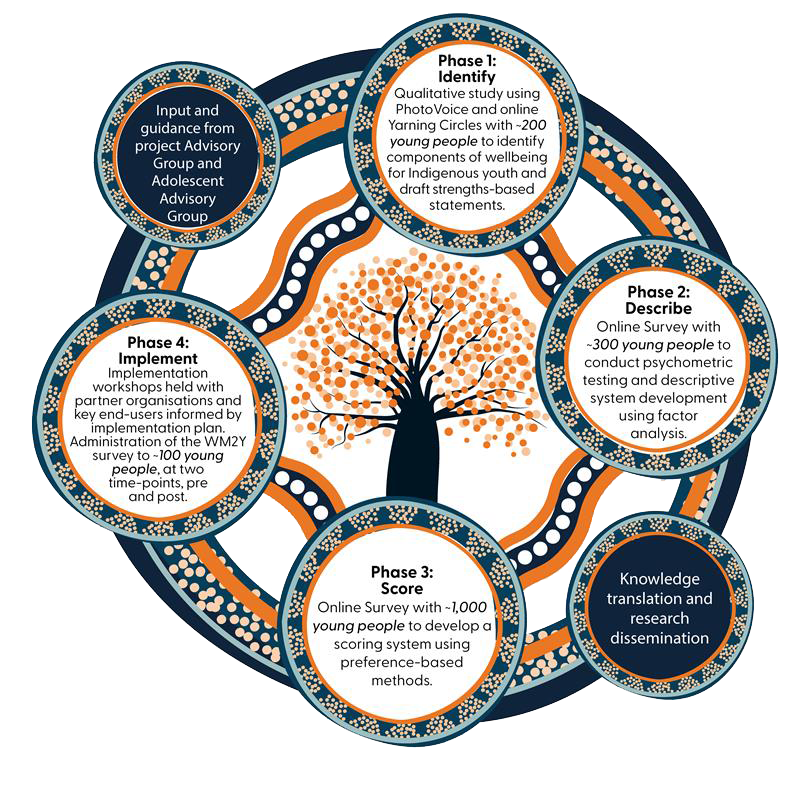
Phase 1 - Completed
Young Aboriginal and Torres Strait Islander participants will be given a digital camera to use for the project and then to keep. With help from local mentors, young people will be asked to take 3-10 photos over a week of things in their community and lives that they feel are important to their own wellbeing.
After taking photographs of things that are important to them and their wellbeing, young people will join a Yarning Circle, co-facilitated by a local mentor and one of our trained Aboriginal and Torres Strait Islander Research Officers. During the Yarn, some photos from the Wellbeing Photovoice Project will be shown to the group to help start some Yarning about wellbeing and what matters to young people in their community.
Phase 2 - Completed
Aboriginal and Torres Strait Islander young people were invited to complete a survey to help us work out the domains and items of wellbeing within the measure, and which items in the measure are the most important.
Phase 3 - Completed
Aboriginal and Torres Strait Islander young people were invited to complete a survey to help us determine the which aspects are most important, and the scoring system for the measure.
Phase 4 - Completed
Participants involved in a local program, were invited to complete the WM2Y measure pre & post program participation, to assess the use of the measure in practice. Measure is not yet publicly available.

The WM2Youth yarning with youth in Karratha
Thank you
The What Matters 2 Youth project team would like to acknowledge and thank the young people and their mentors, families and communities from around the country, who so generously shared their time, perspectives and wisdom with the project.
We also thank the Project Advisory Group members who provided the team with invaluable guidance and input.
Big thank you to all the sites and all who partnered with the research team throughout this study to help involve as many First Nations young people in the development of this wellbeing measure as possible.

Online Yarning Circle Feasibility Study
Yarning Circles are an important way of talking to and sharing with Aboriginal and Torres Strait Islander people. Researchers often use Yarning Circles because it’s a culturally appropriate way of sharing information. When the COVID-19 pandemic hit, our What Matters researchers realised that it might not be possible for Aboriginal and Torres Strait Islander people to always get together in person to have a Yarn. For this reason, our research team decided to see if we could still Yarn in the same way online, using teleconferencing software (like Zoom). We plan to use this method for some sites in the WM2Youth project.
We conducted a pilot trial of Online Yarning Circles with young Aboriginal and Torres Strait people to see if this was an effective way to yarn with our young people. Our researchers trained other young Aboriginal and Torres Strait Islander people to conduct the Yarning Circles.
We will be publishing a journal article on how we did this and its effectiveness, which will be uploaded to our Publications page once it has been accepted and becomes publicly available.
The Yarning Circle Facilitators

Pictured (from left to right): Mr Brian Arley, Ms Elisha Clements-Anderson, Dr Kate Anderson, Ms Alana Gall, Professor Gail Garvey, Ms Zyana Gall and Dr Tamara Butler.
Taken at the Facilitator Morning Tea.

Pictured (from left to right): Ms Caitlin Wharton, Ms Alana Gall, Dr Tamara Butler, Ms Zyana Gall and Ms Lauren Seden
Taken at the Facilitator Training Day.
Ethics
We received ethics approval to conduct the Online Yarning Circle Feasibility Study from the Human Research Ethics Committee of the Northern Territory Department of Health and Menzies School of Health Research (HREC-2020-3735).